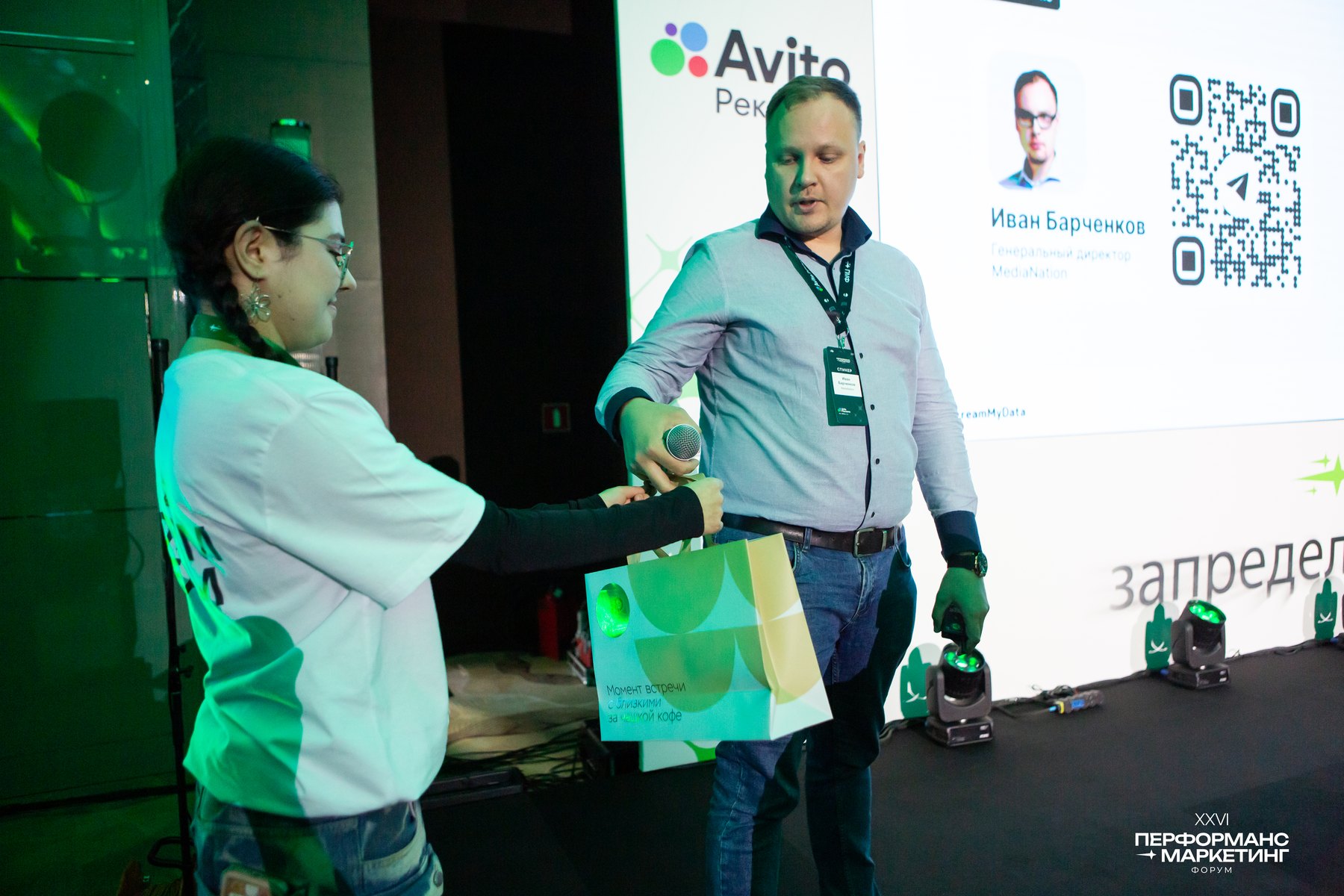
All SEO analytics in one report.
On September 29 at Performance Marketing Forum I showed how StreamMyData brings SEO analytics into a single report and what the AI agent does with that data. StreamMyData won the “Best service on the performance market” category and took the audience choice award in the same category.
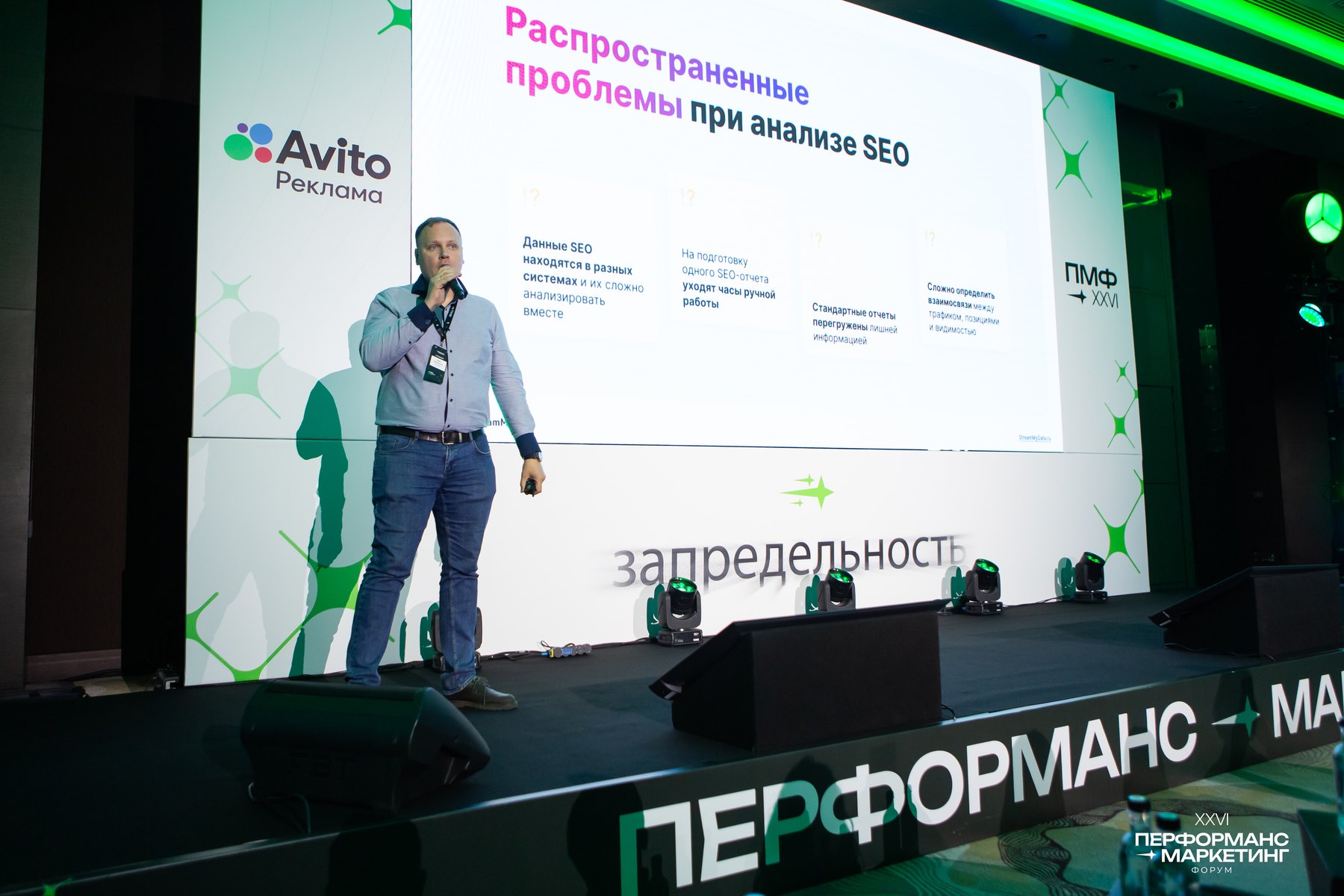
The recording from the hall came out in poor quality, so the talk is retold in text: the flow follows the transcript, the numbers come from the slides (in Russian). The AI agent demo video I played on stage is below.

Where it started
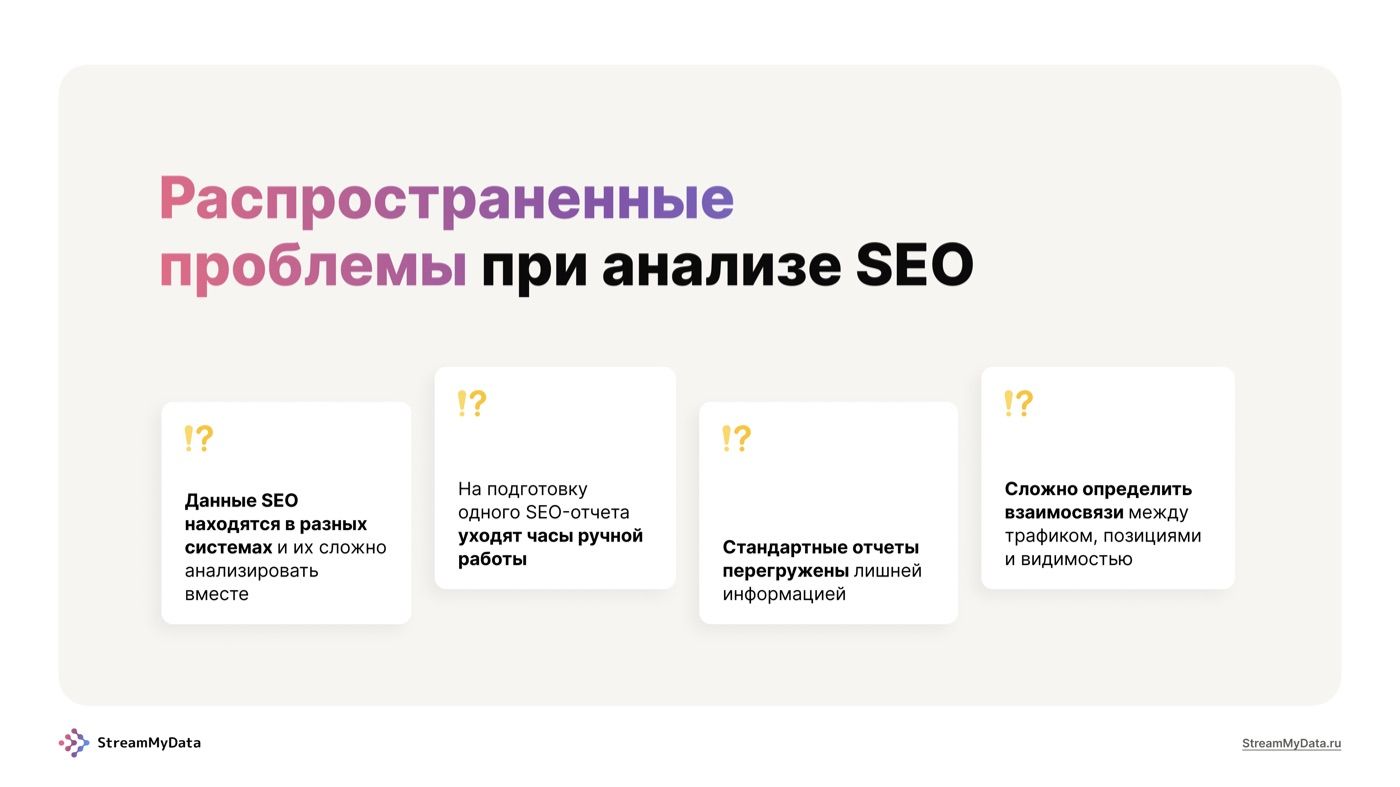
Over the agency's years we kept seeing the same pains in SEO. Data sits in different systems and is hard to analyze together. Preparing one report takes hours of manual work, sometimes days. Standard reports are overloaded with noise. And it's almost impossible to quickly see how traffic, rankings and visibility are connected.
At some point we decided to build a market standard for this: a single system any specialist can work with, one that handles the everyday routine.
One report instead of a dozen tabs
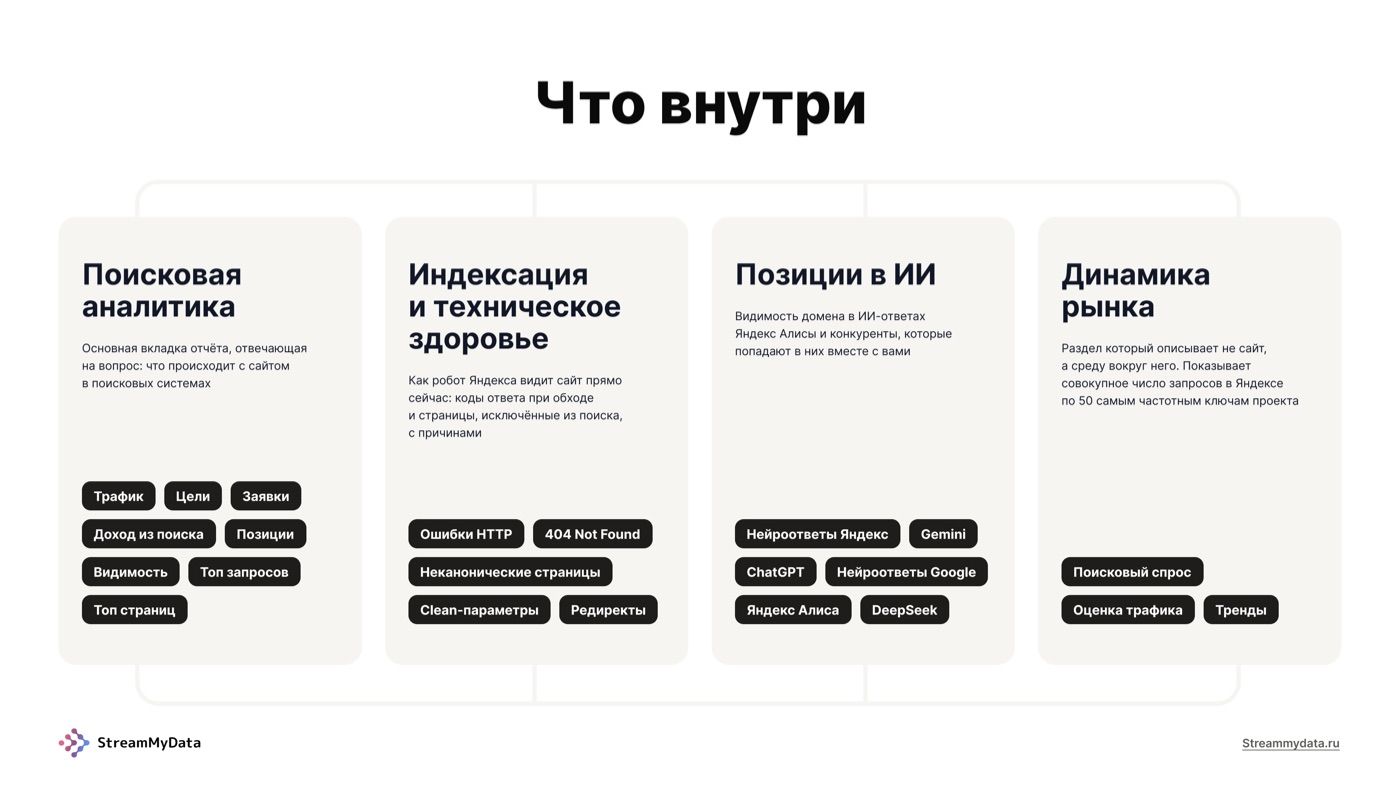
The report pulls data from Yandex Metrica, Google Search Console, Wordstat, Yandex Webmaster, Topvisor, product feeds and our own rank tracking. It has four blocks:
- Search analytics — traffic, goals, leads, search revenue, rankings, visibility, top pages.
- Indexing and technical health — how the Yandex crawler sees the site right now: errors, 404s, non-canonical pages, redirects.
- AI visibility — presence in Yandex and Google AI answers, in Alice, ChatGPT, Gemini and DeepSeek. Part of search traffic already goes there, and it needs measuring too.
- Market dynamics — demand in your category: is the market growing, or are you?
Conclusions, not charts
We didn't stop at charts. The system analyzes every chart and every element, compares them with each other and surfaces signals, growth points and anomalies on its own. You see when something bad happened and when something very good did.
And it's all tied to money. The report evaluates not just traffic but goals, leads and revenue: you see right away what actually makes money and what doesn't.
For e-commerce there's a special feature: you can analyze products, not page URLs. Connect a YML/XML product feed and see, for example, how TVs of a certain brand and screen size behave: are their rankings growing, and if not, why.
Another big part of any specialist's job is reporting to management. We built it right into the product: share a report by link or export it to HTML or PNG, including branded versions. There's also a task planner so agreements don't get lost.
Ask instead of waiting for an analyst
On top of the report sits an AI assistant: it explains why traffic, rankings and visibility changed, compares search engines, periods and channels, and suggests growth points. Typical tasks have ready-made skills: metric anomaly detection, keyword research, product feed audit, dashboard building. Next are the four cases I showed on stage.
Case 1. Fraud from a contractor
A client had suspicious traffic and suspected a contractor was inflating it. The AI agent pulled two weeks of raw Yandex Metrica visits and analyzed them. The anomalies:
On top of that, the same IP subnets were active across all three traffic sources.
A detailed breakdown of this investigation is in a separate post.
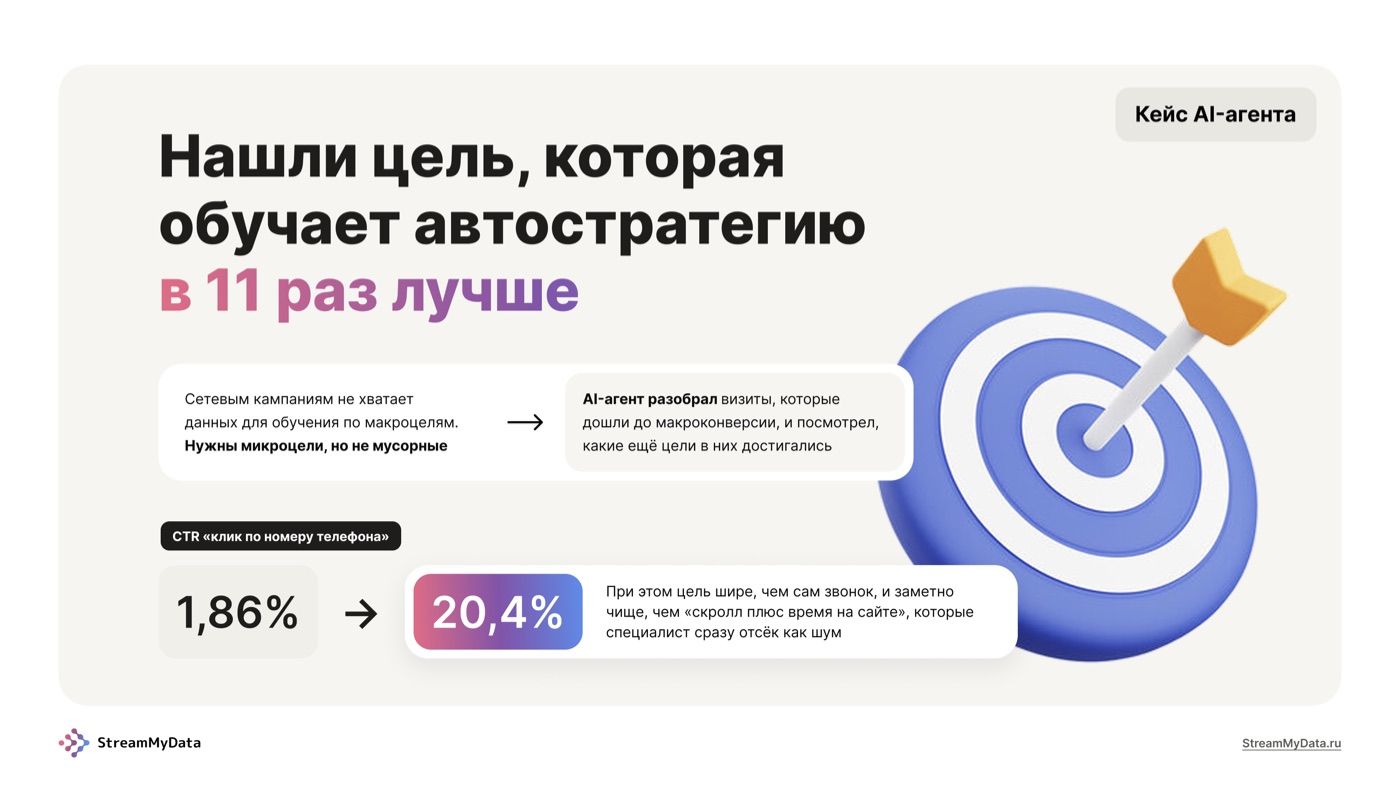
Case 2. A micro-goal that trains the auto-strategy 11× better
Network campaigns lack data to learn from macro-goals. They need micro-goals, but not junk ones. The AI agent analyzed visits that reached a macro-conversion and checked which other goals were reached in them. The basic “phone number click” goal fired in 1.86% of visits; the goal the agent found fired in 20.4%:
The new goal is broader than the call itself and noticeably cleaner than “scroll plus time on site”, which the specialist had immediately dismissed as noise.
Case 3. An ad account audit in minutes instead of days
The AI agent read an entire Yandex Direct account: campaigns, strategies, ad groups, ads, keywords, bids, adjustments, retargeting and feeds. The output: a list of errors, examples and recommendations for fixing them. In large accounts with around a thousand campaigns, a person simply can't explain a drop this fast.
Case 4. Traffic drop causes: a week → 30 minutes
An e-commerce project with over a million users, a huge number of categories and subcategories and almost no obvious errors. The task: find why traffic dropped. We gave the agent the inputs, and in 3 minutes it returned the causes, attribution to specific categories and keywords, and an action plan. The whole investigation took 30 minutes instead of a week.
What follows from this
An AI agent doesn't replace an SEO specialist. It takes over the part of the work that used to eat hours: collecting data, reconciling sources, finding what broke and explaining it to management. The specialist keeps what they're paid for — decisions.
And it's gratifying that not only colleagues on the jury valued this but the audience too: the audience choice award means people really need this in their work.